
I just returned from an incredible trip to Mexico City, where I experienced their annual Día de los Muertos, or Day of the Dead, celebrations.
And WOW. What an experience!
There were vibrant colors everywhere, beautiful flowers, incredible art, music, dancing, parades, laughter, and so much joy. I loved every minute of it.
But beyond the sights, food, and festivities, I came home with two takeaways that I think are worth sharing. They're both connected to something I talk about often in my coaching: We don't have to keep thinking, believing, or living the way we always have.
Sometimes all it takes is a new experience or a different perspective to open our minds to possibilities we hadn't considered before.
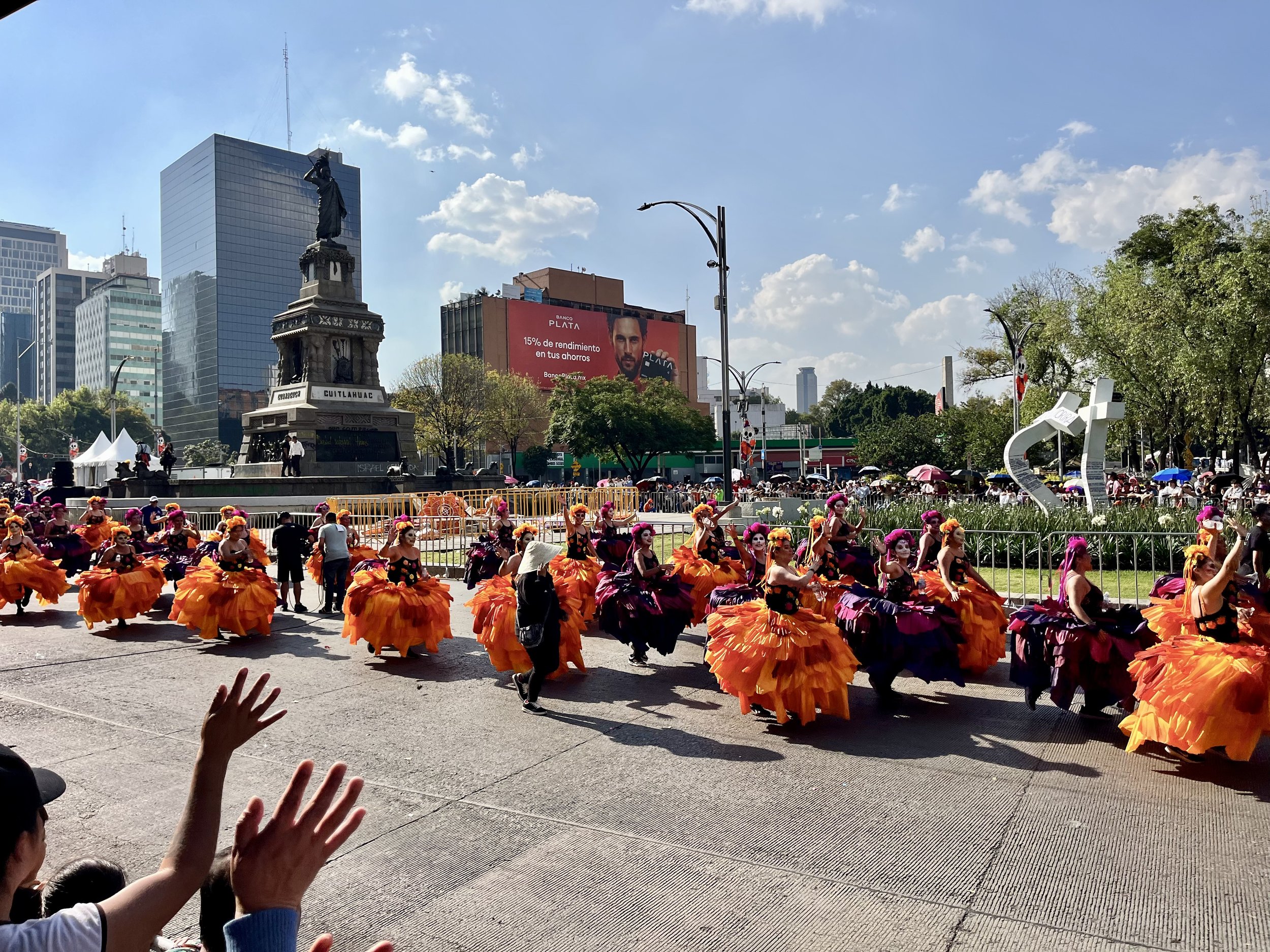
The parade in Mexico City was incredible!
Lesson #1: Travel Is a Fabulous Pattern Interrupt
One of the things I love most about traveling is how it shakes us out of our usual routines.
Think about how much of our everyday lives we spend on autopilot. We drive the same roads, eat similar foods, interact with many of the same people, follow familiar routines, and often think the same thoughts.
And there's nothing necessarily wrong with that! Routines can be incredibly helpful.
But sometimes we get so comfortable in our patterns that we forget there are other ways to experience life.
Mexico City was a wonderful reminder of that.
It was rare to find menus in English or to encounter people who spoke English, so I got to dust off the Spanish I learned about 30 years ago! (Let's just say it was a little rusty.)
We navigated unfamiliar places, tried new foods, learned about traditions, and got to see how another culture approaches things differently from our own. I LOVED it.
It felt like such a gift to learn from others, and it also made me reflect on my own culture, beliefs, and habits.
There's a reason new experiences can feel so refreshing.
Our brains are constantly learning and adapting. This ability, called neuroplasticity, allows us to strengthen and change neural connections throughout our lives.
Novel experiences can engage our attention, challenge our assumptions, and give our brains new information to work with. And when we're away from our usual environment, we have an opportunity to interrupt some of the automatic habits and thought patterns that keep us feeling stuck.
It's one reason I encourage my life coaching clients to bring more novelty, curiosity, and even a little adventure into their lives.
And here's the good news: You don't have to travel internationally to experience this!
You could explore a town you've never visited, take a class, try a new activity, visit a museum, eat food from another culture, or simply strike up a conversation with someone whose life looks different from yours.
The point isn't necessarily to go somewhere far away. It's to step outside your usual patterns and give yourself an opportunity to experience something NEW.
Lesson #2: Sometimes Trying On Someone Else's Belief Can Help You
This was the bigger takeaway for me, and one I wasn't expecting. I grew up associating death with tremendous grief, sadness, and loss. When someone dies, we mourn. We miss them. We feel the emptiness of their absence.
And of course, there's nothing wrong with grieving. It's part of loving someone deeply.
But what I experienced during Día de los Muertos was a different way of relating to death and remembering loved ones.
In this Mexican tradition, many families believe that their loved ones who have died return to visit during these special days. Families create beautiful ofrendas (offerings or altars) with photographs, flowers, candles, favorite foods, and meaningful objects to welcome and honor them.
And rather than focusing only on the sadness of losing someone, there's also an enormous emphasis on celebrating their life and continuing that connection. The JOY was palpable.
There was dancing, music, laughter, colorful art, smiling faces, and such a beautiful sense of celebration. It really moved me. Now, I'm not saying I came home completely changing how I feel about death. I still deeply miss the people I've lost, and I always will. But I found myself considering something I hadn't really allowed myself to consider before.
What if the people we've lost are closer to us than we think? What if there's a way to feel connected to them, even though they're no longer physically here? I don't know what happens after death. None of us knows for certain.
But I found this perspective comforting. And I realized that it feels better to me to leave room for that possibility than to assume that death means complete separation. And THAT got me thinking.
How many other beliefs do we hold simply because that's what we learned growing up?
What If Some of Your Beliefs Aren't Actually True? We all develop beliefs about ourselves, other people, and the world based on our upbringing, experiences, culture, and the messages we've received throughout our lives.
Some of these beliefs serve us beautifully. Others? Not so much.
Maybe you grew up believing that being successful means working really hard ALL the time.
Maybe you learned that putting yourself first is selfish.
Maybe you believe that you have to make everyone happy to be loved.
Or perhaps you've been carrying around thoughts like:
I'm not good enough.
I have to be perfect.
I'm too old to change.
Bad things always happen to me.
Things are never going to get better.
I can't handle uncertainty.
I don't deserve to be happy.
We can repeat these thoughts so often that they start to feel like facts. But just because you've believed something for a long time doesn't mean it's the whole truth.
In coaching, one useful practice is learning to examine our automatic thoughts and consider alternative interpretations. We aren't trying to trick ourselves into believing something that isn't true. We're learning to be more flexible in how we interpret our experiences. And that flexibility can make a tremendous difference in how we feel and what we do next.
For example, imagine you've spent years believing: I'm not good enough.
How does that belief affect your life? Maybe you hold yourself back from opportunities. Maybe you compare yourself to others, overwork to prove your worth, or struggle to accept compliments.
Now imagine you started looking for evidence that challenges that belief. You remember difficult things you've overcome, people you've helped, skills you've developed, and moments when you showed up even though you were scared.
Perhaps a more helpful belief becomes: I'm a work in progress, just like everyone else. I have strengths, I have value, and I don't need to be perfect to be enough.
How might THAT belief change the way you feel and behave? It's not about pretending everything is wonderful or ignoring real problems. It's about giving yourself permission to consider that the story you've been telling yourself might not be the only story available.
Try This: Question One Belief This Week
Here's a simple exercise you can try.
1. Notice a belief that's making life harder.
Maybe it's something about yourself, your relationships, your work, or your future. Write it down.
2. Ask yourself: Is this absolutely true?
What evidence supports it? And just as importantly, what evidence might challenge it? Try to be fair. Our brains have a natural negativity bias, so we often overlook information that doesn't fit our existing story.
3. Notice what this belief is costing you.
How do you feel when you believe it? Does it make you anxious, discouraged, resentful, or stuck? Does it cause you to avoid things, overwork, or doubt yourself?
4. Try on another perspective.
What might someone with a different upbringing or life experience believe? What would you tell a friend who was thinking this way? Can you come up with a different belief that's both realistic AND more supportive?
5. See how it feels.
You don't have to believe the new thought completely right away. Just notice whether it creates a little more hope, peace, confidence, or possibility. And then look for evidence in your everyday life that supports this new perspective.
Over time, practicing a more balanced way of thinking can help old patterns lose some of their grip.
A Final Thought
I'm so grateful for my trip to Mexico City. Yes, the food, sights, people, and celebrations were wonderful. But what I appreciate most is that I came home thinking a little differently than when I left.
And isn't that one of the greatest gifts of travel, learning, and connecting with people who see the world differently than we do? We don't have to adopt every new idea we encounter. We don't have to abandon our traditions or the beliefs that matter to us. But we CAN stay curious.
We can question the beliefs that are keeping us stuck. And we can give ourselves permission to try on another way of seeing things. Maybe the world, and our lives, hold more possibilities than we've been allowing ourselves to see.
What belief might YOU be ready to reconsider?
💛 If you loved this email, forward it to someone who might love it too.
⬆️ Want more help…? On Instagram, I share a TON of tips and inspiration to help live a life with more joy and less stress. I'd love to see you there! @uplevellifecoach Just click HERE!
⬆️ Would you love more personalized support?
Reading about these tools is one thing. Figuring out how to apply them to your life…well, that's another. That's where I can really help!! I've done it myself and helped countless clients do it too. We can get to the root of what's keeping you stressed, and really change things so that you feel good again. Ping me HERE!
💛 More joy. Less stress. A life that feels good to live.