
When I was little, I grew up in a house that was never quite finished. There were blue tarps hanging around, projects that never got completed, and Christmas lights that stayed on the trees year-round. Not in a charming, festive sort of way. They just never came down. I remember feeling embarrassed about our house. I wished it looked like other people's homes.
I think that's one of the reasons I care so much about my surroundings today. I LOVE having a beautiful home. It doesn't need to be fancy or perfect, but I want it to feel peaceful, welcoming, and cared for. Which brings me to my current predicament.
I live in a condo, and my next-door neighbors have a habit of leaving things outside. Dog poop bags, trash, holiday decorations that hang around WAY past their expiration date. And now they're selling their place and leaving more messes behind.
And it has been driving me CRAZY. I find myself looking at it, getting annoyed, thinking about how inconsiderate it is, and then getting annoyed all over again. Sometimes I even catch myself looking to see if they've cleaned anything up.
And the irony is not lost on me. I'm a life and health coach who teaches people how to manage stress, regulate their nervous systems, shift unhelpful thinking patterns, and stop letting things outside their control hijack their happiness. Yet here I am, letting someone else's trash affect mine.
So I thought I'd share what I'm doing about it, because maybe you have your own version of this.
Maybe it's a coworker who never pulls their weight. A family member who makes comments that get under your skin. A spouse who leaves their stuff everywhere. Or someone whose choices you simply cannot understand. Whatever it is, sometimes the smallest things can take up a ridiculously large amount of space in our heads.
Why do certain things get under our skin SO much?
One thing I've learned through my own experiences and my work as a life coach is that our reactions aren't always just about what's happening in the present. Sometimes our past experiences make certain situations especially upsetting. For me, I know the mess outside my home touches an old nerve. As a kid, I didn't have much control over my environment, and I remember how that felt. Today, having a home that feels beautiful and peaceful matters to me.
So when someone else's behavior interferes with that, it feels bigger than a few bags of trash. And recognizing that has been helpful. Instead of judging myself for being so irritated, I'm getting curious about why this matters so much to me. That's something I encourage my clients to do, too.
Rather than asking, "Why am I so ridiculous about this?" try asking, "Why might this bother me so much?" Understanding our reactions doesn't automatically make them disappear, but it can help us respond more thoughtfully.
The simple exercise I'm using to reclaim my peace
I've decided to take a tool I regularly teach and put it to work in my own life. I'm making two lists. And honestly, I'm giving myself permission to have a little venting session while I'm at it.
On one side of the paper, I'm writing: THINGS I CAN CONTROL On the other: THINGS I CANNOT CONTROL I'm listing everything that's been bothering me, frustrating me, or taking up too much of my mental energy.
For my neighbor situation, here's the start of what that looks like:
Things I CAN control:
Whether I communicate my concerns
How much time I spend talking about or dwelling on the mess
How I care for and enjoy my own home
Whether I pause and regulate myself when I feel irritated
Where I choose to direct my attention
How I respond when the frustration comes back
Things I CANNOT control:
Whether my neighbors care about the mess
Their personal standards of cleanliness
Whether they agree with me
Their decisions and behavior
Whether they clean when moved out
And here's where the real work begins.
Step 1: Get into action on what you CAN control
This is important because letting go doesn't mean becoming passive. It doesn't mean tolerating disrespect, ignoring problems, or pretending that things don't bother us. Sometimes we absolutely need to speak up, set boundaries, make requests, or take action. But once we've identified what we can reasonably do, we can stop spinning our wheels trying to control the rest.
I often ask my coaching clients: "What's yours to do here, and what's not yours to carry?" (I especially love this question for people-pleasers, perfectionists, and those of us who have spent years feeling responsible for everyone and everything around us.) It's incredibly freeing to recognize that we can take responsibility for our own actions without taking responsibility for everyone else's.
Step 2: Practice letting go of what you CANNOT control
This is the harder part for me. I came across a reminder that really resonated and I even printed it out and hung it on my fridge: "Peace comes when you realize that everything that's out of your control should be out of your mind, too."
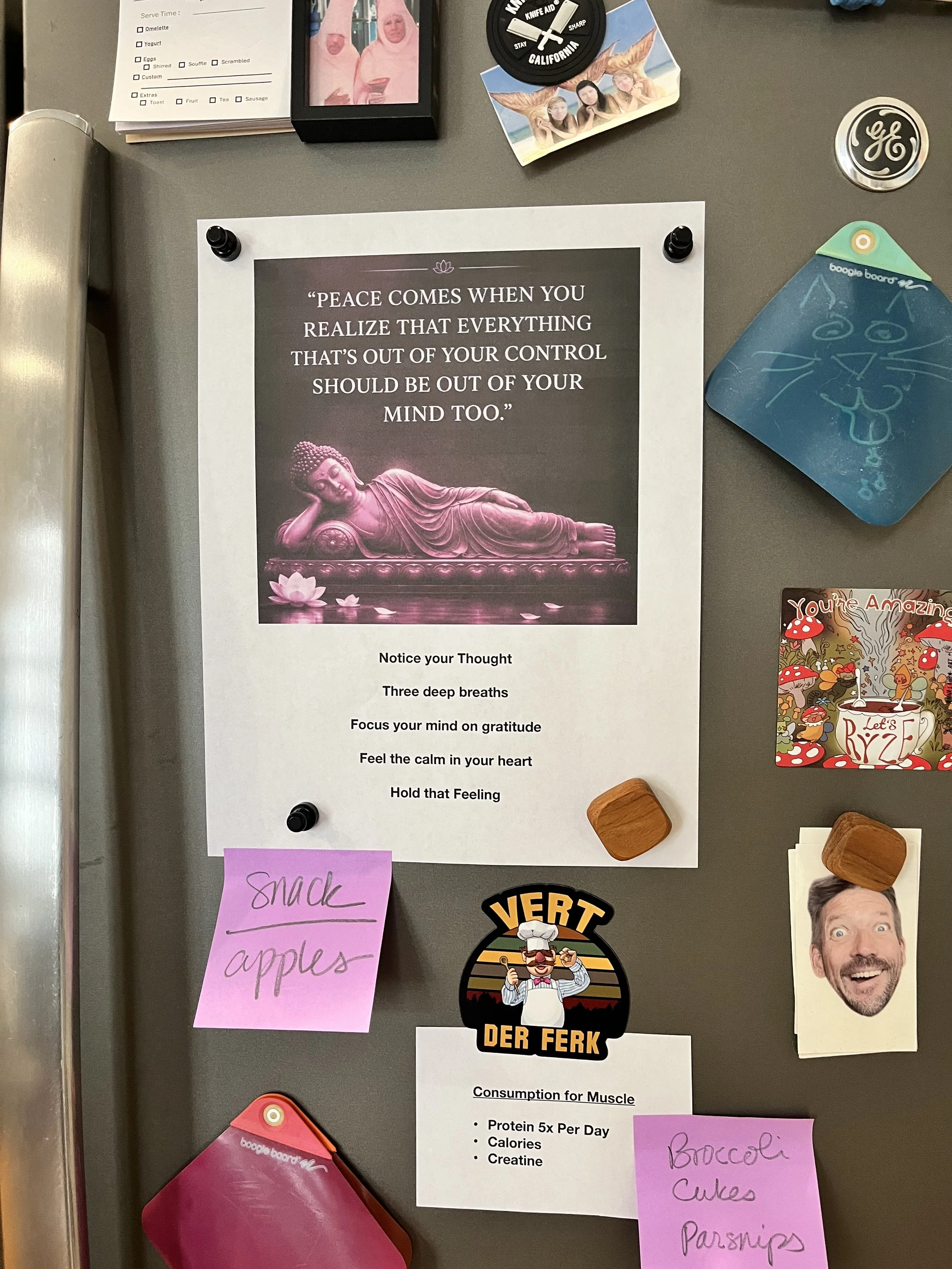
I really did put it on our fridge! It’s what I needed this week.
Now, I know we can't just snap our fingers and stop thinking about something. If only! But we CAN get better at recognizing when we're mentally hanging on to something that isn't ours to control. For example, I might be enjoying my morning coffee when suddenly I start thinking about the trash outside. And there it is again. That familiar wave of irritation.
Instead of following that thought down the rabbit hole, I'm practicing noticing it. Oh, there I go again. I've already decided what I can do about this. I don't need to keep thinking about it right now.
And then I deliberately redirect my attention. Sometimes to something I'm grateful for. Sometimes to the task in front of me. Sometimes to something beautiful in my home. And yes, sometimes the thought comes right back five minutes later. So I practice again. And again. This is something I really want people to understand: Letting go is often a practice, not a one-time decision.
Step 3: Stop feeding the frustration
There's actually some interesting science behind why this matters. Our brains have a negativity bias. We naturally pay more attention to things that seem threatening, wrong, or unpleasant. And when we repeatedly replay an upsetting situation in our minds, we can keep the emotional response going long after the original trigger. Psychologists call this rumination. It's that mental loop where we revisit the same frustrating thought without moving toward a solution. And it can be exhausting. One helpful way to interrupt rumination is to ask: "Is thinking about this right now helping me solve anything?"
If the answer is yes, maybe there's an action to take. But if the answer is no, I can acknowledge the thought and gently shift my attention. I'm not trying to suppress my feelings or convince myself that the situation is okay. I'm simply choosing not to keep adding fuel to the fire. And if my body is already worked up, I might take a few slow breaths, relax my shoulders, or go for a walk before trying to shift my thinking. Our bodies and minds are connected, and sometimes calming the body makes it much easier to change our response.
The bigger lesson I'm learning
I think many of us spend a surprising amount of our lives wishing things were different. If only that person would change. If only my boss would recognize how hard I work. If only my kids would make better choices. If only people would be more considerate. And sometimes those wishes are completely reasonable.
But the reality is that other people aren't always going to behave the way we want them to. And if our peace depends on everyone around us doing what we think they should do, we're going to spend a lot of time frustrated. I don't want that. I want to be someone who can advocate for herself, address problems, set healthy boundaries, and then get back to enjoying her life. That's the goal!! (Not to become someone who never gets annoyed, but to become someone who doesn't stay stuck there.)
And clearly, I'm still practicing. 😂
Your challenge this week: The Two-List Reset
Grab a piece of paper and draw a line down the middle. Label one side Things I CAN Control and the other Things I CANNOT Control. Then let it all out. Whatever is bothering you, worrying you, or taking up too much of your mental energy. Once you've finished, look at your CAN control list and choose one helpful action. Then look at your CANNOT control list and ask yourself: Am I willing to stop giving these things so much of my attention?
You don't have to stop caring. You don't have to agree with what's happening. And you certainly don't have to pretend you like it. You just don't have to keep carrying it around in your head all day. And when those thoughts return, because they probably will, gently remind yourself: "I've done what I can. The rest isn't mine to control." Then come back to your life. Because there are so many better things deserving of your energy!!
And I don't know about you, but I want more of my energy going toward the things that make life feel GOOD.
💛 If you loved this article, forward it to someone who might love it too.
⬆️ Want more help creating a life with more joy and less stress? On Instagram, I share a TON of tips and inspiration to help you live a life with more joy and less stress. I'd love to see you there! @uplevellifecoach
⬆️ Would you love more personalized support? As a certified life and health coach, I help people move beyond stress, anxiety, overwhelm, and burnout by teaching practical, science-backed tools they can use in everyday life. If you're tired of overthinking, feeling stuck, or allowing things outside your control to steal your peace, I'd love to help. Ping me HERE!
💛 More joy. Less stress. A life that feels good to live.