
The Science of Awe: A Surprisingly Simple Way to Reduce Stress and Feel Happier
What if one of the things missing from our lives isn't another stress-management technique...but awe?
Think about the last time something stopped you in your tracks.
Maybe you looked up and saw an incredible sunset.
You stood beside the ocean.
A song gave you goosebumps.
You looked at the stars on a clear night.
You saw a magnificent old tree, watched a child experience something for the first time, or watched a professional glassblower create a pitcher in seconds.
For a moment, you weren't thinking about your inbox. Or your schedule. Or the thing you needed to fix.
You were simply thinking: Wow.
There's a name for that feeling: awe.
And researchers are discovering that it may be surprisingly good for our well-being.
What Is Awe?
Awe is an emotion we experience when we encounter something that feels vast, extraordinary or bigger than our usual frame of reference.
We often associate it with dramatic experiences—standing at the Grand Canyon, seeing the Alps, watching a spectacular concert.
BUT - But awe can also be remarkably ordinary, in your home or back yard:
You can experience it looking at the moon.
Listening to music.
Watching birds.
Seeing incredible art.
Walking through the woods.
Looking closely at something in nature.
Watching someone demonstrate extraordinary talent, courage or kindness.
The opportunity is all around us.
The problem is that many of us are moving too quickly to notice it.
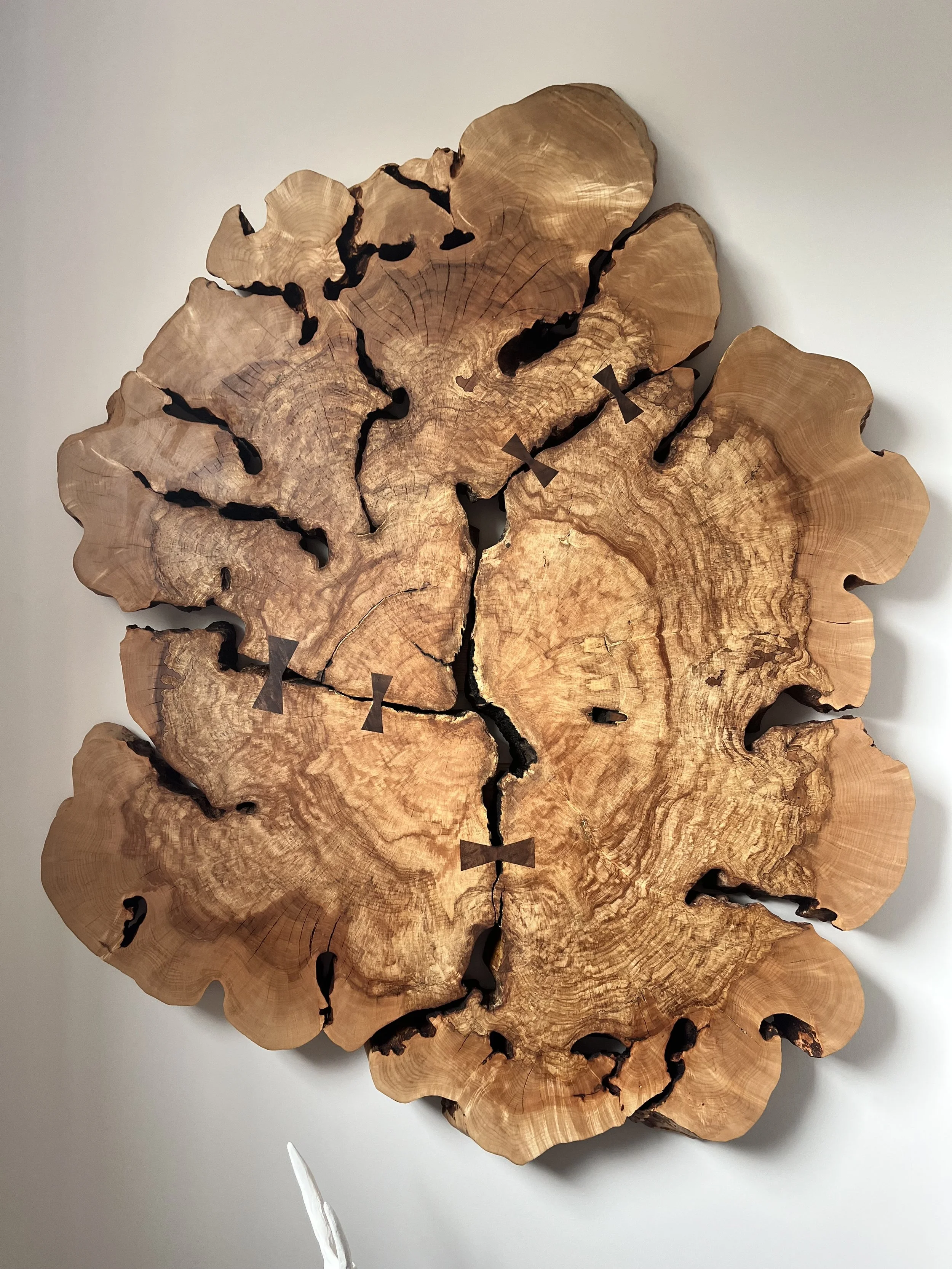
This is a gorgeous wood slab for sale at THIS shop near my hometown. I think it is the most beautiful cross section I’ve ever seen. Awe-inducing for SURE! And look at the hand-carved bow ties. Stunning.
What Awe Does to Stress
When we're stressed, our attention tends to narrow.
We zoom in.
The emails feel overwhelming.
The deadline and to-do’s feel never-ending.
The traffic feels turtle-paced.
The difficult person feels enormous, too hard to handle or even scary.
Whatever is directly in front of us can start to feel like our entire world.
And wwe can do something interesting: it changes our perspective.
Research has found that people who experience more awe tend to report lower levels of daily stress. Experimental research has also found that inducing awe can reduce people's reported stress and physiological arousal when discussing everyday stressors.
In other words, the problem doesn't necessarily disappear.
But our relationship to the problem can change.
The world suddenly feels bigger than the thing we're worrying about.
We May Have an Awe Deficit
I sometimes wonder whether modern life has created an accidental shortage of awe.
We're surrounded by things that could amaze us.
But we're rarely fully looking at them.
We photograph the sunset instead of watching it.
We walk through beautiful places while checking messages.
We listen to music while simultaneously answering emails.
We drive past the ocean without looking because we've seen it hundreds of times.
Our brains become accustomed to extraordinary things.
And then we rush right past them.
This isn't about blaming technology or pretending we should spend our lives staring dreamily at flowers.
It's simply recognizing that attention matters.
We can't experience what we don't stop long enough to notice.
Try an “Awe Walk”
Here's an experiment. Take a 10- or 20-minute walk with a slightly different purpose. Don't walk primarily for exercise. Don't listen to a podcast. Don't make phone calls.
Instead, look for something that surprises you. Look up at the trees instead of down at the sidewalk. Notice the sky. Look at the architecture. Listen to birds. Notice light, color, shadows, movement and scale.
Become curious about things you've stopped seeing because they're familiar.
You aren't trying to force yourself to feel anything.
You’re simply creating the conditions where finding awe is more likely to happen!
Create an Awe Menu
You can also make a personal list of things that reliably make you feel wonder. Mine might be different from yours.
Maybe yours includes:
live music
mountains
thunderstorms
museums
old architecture
watching the sunrise
the ocean
theatre
animals
astronomy
incredible athletic performances
beautiful gardens
watching someone master their craft
The question isn't What should impress me?
It's: What makes ME stop and feel something?
Then deliberately put a little more of that into your life.
Happiness isn’t just removing the stressful things, it can be adding in more good. I think this is an important distinction.
We spend enormous amounts of time trying to remove discomfort from our lives.
Less stress.
Less anxiety.
Less overwhelm.
Less conflict.
And yes, those things matter.
But well-being isn't simply the absence of unpleasant emotions.
We also need to actively experience the good ones.
Joy.
Connection.
Curiosity.
Wonder.
Gratitude.
Awe.
Sometimes feeling better isn't about fixing another thing that's wrong with us or our lives.
Sometimes it's about becoming more available to what's already good.
Try This for One Week
Once a day, deliberately seek one moment of awe.
Then stop.
Don't photograph it immediately.
Don't post it.
Don't rush to the next thing.
Give yourself a few seconds to actually experience it.
Look.
Listen.
Feel it.
Let yourself think: Wow.
The stressful things will still be waiting. But perhaps they'll feel just a tiny bit smaller when you return.
⬆️ Want more…? Practical tools for stress, anxiety, nervous system regulation, habits, and happiness and just some fun inspo over on Instagram: I’d love to see you there! @uplevellifecoach Just click HERE!
⬆️ Would you love more personalized support?
Reading about these tools is one thing. Figuring out how to apply them to your life…and actually creating lasting change - is another. That’s where I can really help!! We can get to the root of what’s keeping you stressed, calm your nervous system, find practical solutions, and build the habits, boundaries, and mindset shifts that help life feel good again. Ping me HERE!
More joy. Less stress. A life that feels good to live.
Know someone who could benefit from adding awe to their life? Please forward this!